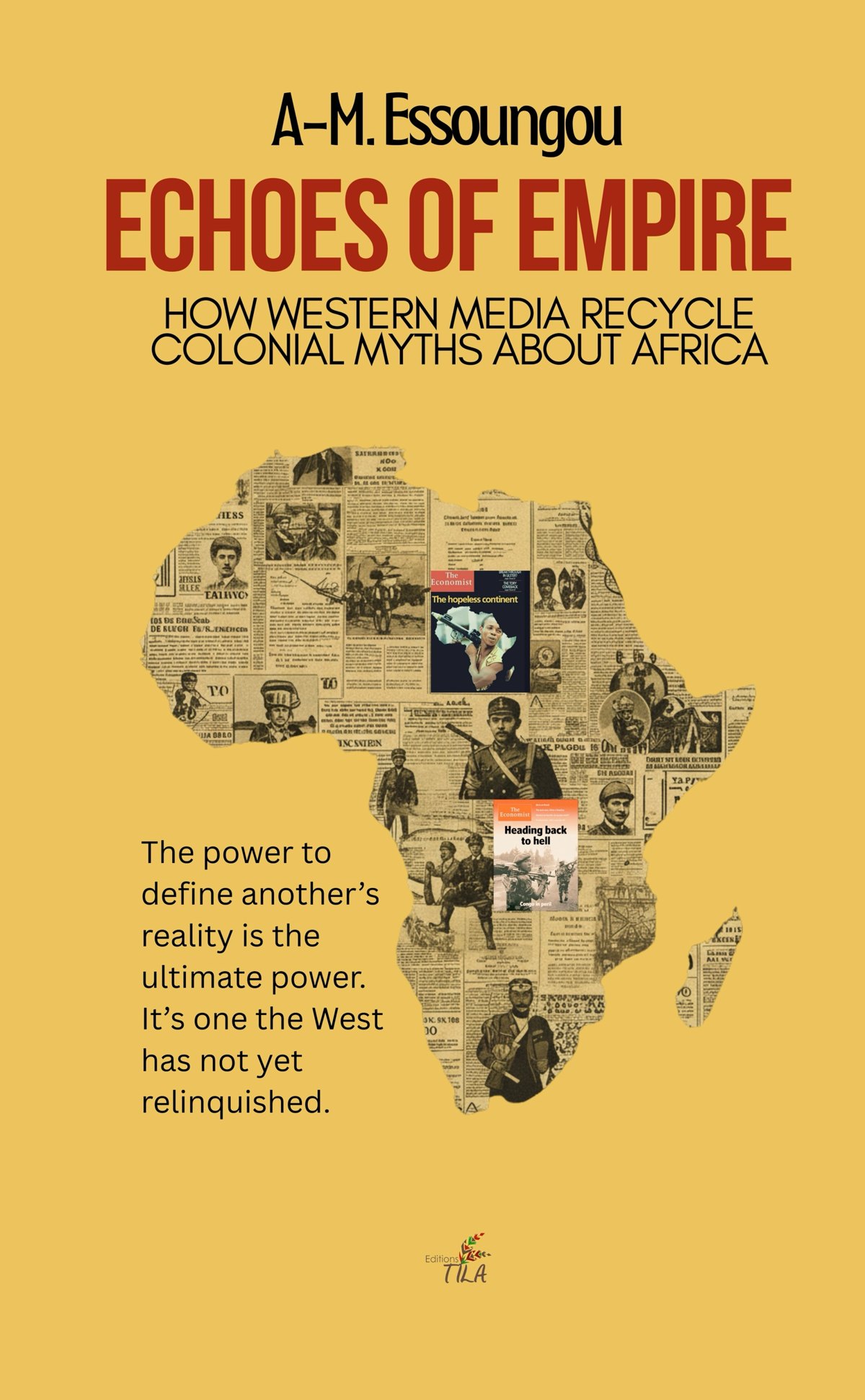
Echoes of Empire
How Western media recycle colonial myths about Africa — a close reading of five years of war reporting, and of the century of writing that made it possible.
What the book argues
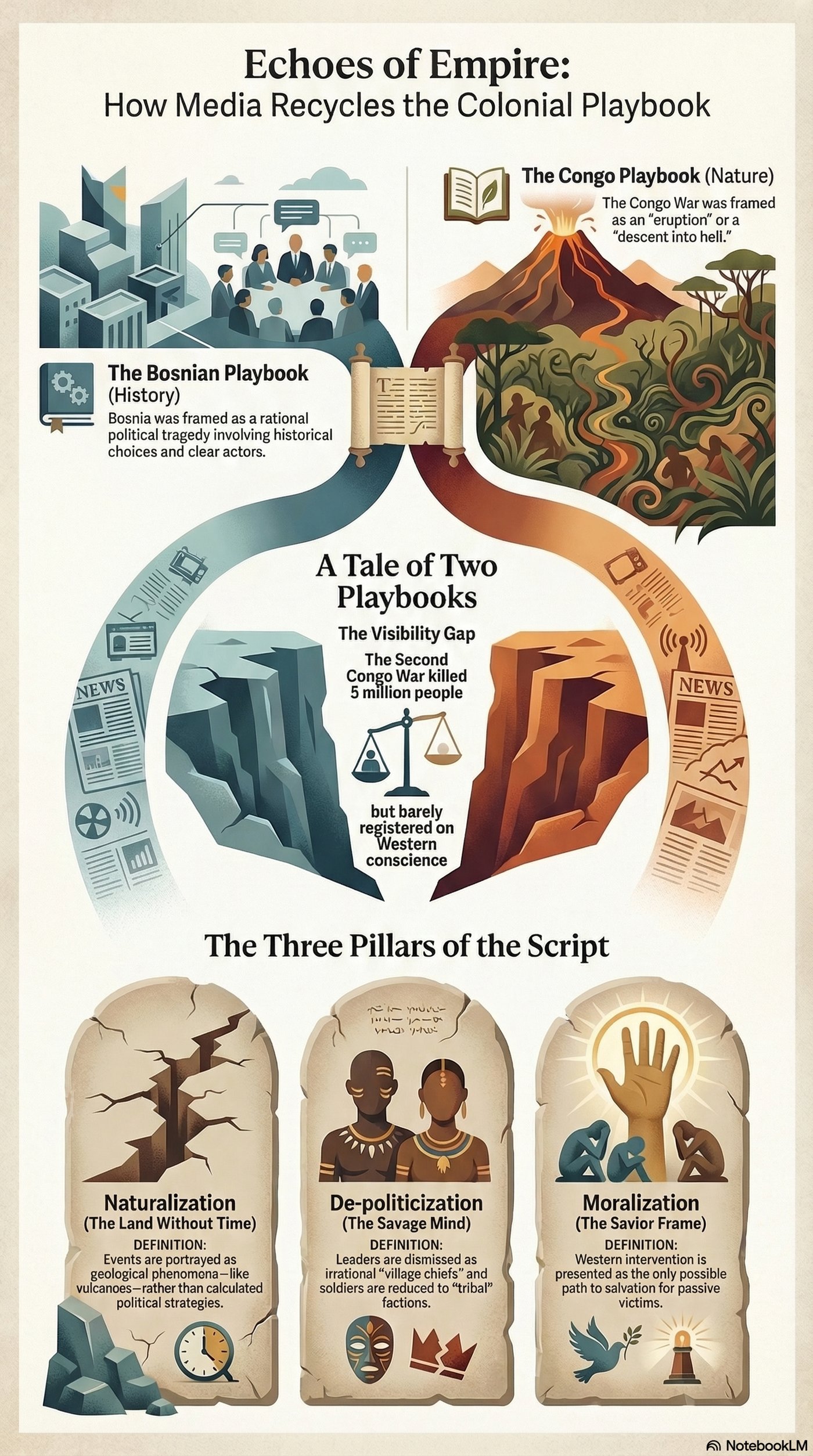
In the mid-1990s, when the world looked at the war in Bosnia, it saw a story it could understand. Readers learned the names of the cities under siege and the names of the men responsible. They were given a vocabulary — ethnic cleansing, geopolitical chessboard — that made the horror legible as politics.
Three years later a war began in the Democratic Republic of the Congo that would kill more people than any conflict since the Second World War. It involved nine national armies and dozens of armed groups. It was, by any measure, one of the central political events of its decade. It was covered as weather.
Echoes of Empire takes that gap seriously. It reads every article on the Second Congo War published in The Economist and Le Point between August 1998 and July 2003, and asks a simple question: where does this script come from?
The answer runs back through Conrad, through Stanley's dispatches, through Hegel's assertion that Africa was “no historical part of the world”, to a body of colonial writing whose vocabulary outlived its politics. The book's claim is not that individual journalists are racist. It is that the machine they work inside was built with those parts, and has never been dismantled.
“This has never been an indictment of individual journalists, many of whom risk their lives to bear witness. It is an indictment of the machine itself.”
Who it is for
Journalists and editors covering the global South; students of media, African studies and international relations; diplomats and aid practitioners who have watched policy follow coverage; and any reader who has finished an article about Africa with the feeling that something was missing but could not name it.
Seven chapters
“The Congo Erupts”
The central paradox: why was a profoundly political event consistently described in the language of natural disaster? Set against the coverage of Bosnia, the two scripts become impossible to unsee.
A Colonial Playbook
Back to the nineteenth century — the administrators, missionaries and explorers who first described Africa as chaotic, timeless and in need of European stewardship. The playbook modern journalists inherit without knowing it.
From Conrad to The Economist
The case study in detail. How reporters recycled the tropes of savagery and chaos, often citing Heart of Darkness explicitly, and in doing so stripped the conflict of political logic.
Why Africa Always Needs Rescuing
How African-led peace efforts were portrayed as doomed by local incompetence, while Western intervention was presented as the only credible path — casting former colonial powers as reluctant but necessary saviours.
Who Gets to Tell the Story?
The question of voice. The near-total absence of the leaders, soldiers and strategists at the heart of the conflict, and the monopoly of the journalist's own analysis, backed by anonymous sources and Western officials.
The Real-World Consequences
Operation Artemis, the 2002 UN panel on illegal resource exploitation, the architecture of public apathy. What flawed frames cost in policy, in aid, and in lives.
Breaking the Frame
A reader's toolkit — the agency gap, the expert problem, the context deficit, the Conrad test — followed by working models of a different journalism, and three rules for a new playbook.
Also included: a full chronology of the Second Congo War, the complete list of analysed articles, and a bibliography of 40 works.
Read the whole book
The complete book, free. Leave an address and the download starts straight away — a copy of the link also arrives by email, so you can come back to it. You will hear from me only about this project: the podcast, the French edition, new teaching material. No list-sharing, unsubscribe any time.
Editions
The argument on one page