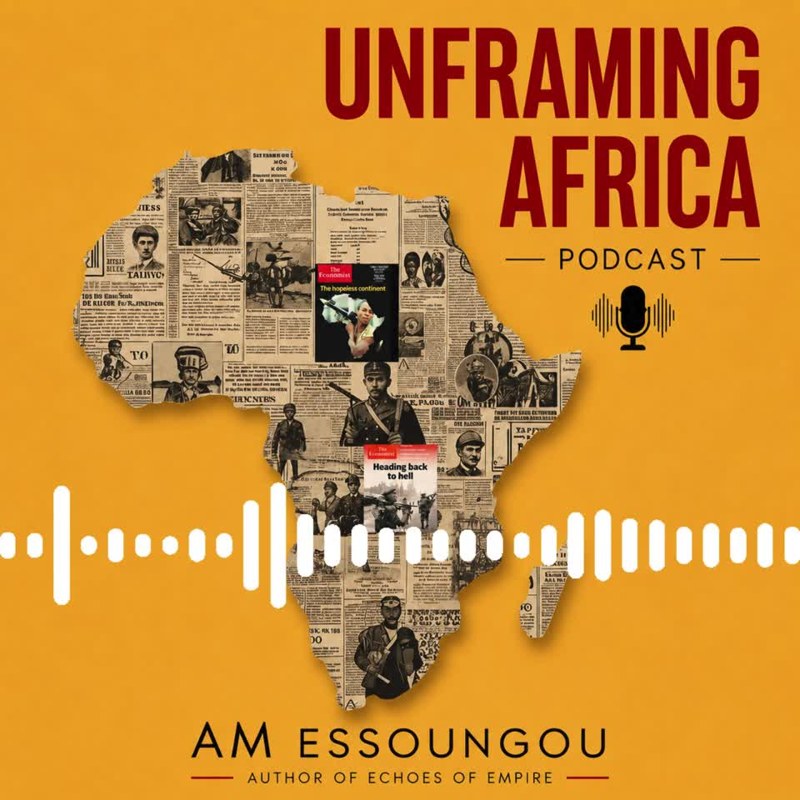
Unframing Africa podcast artwork: a map of Africa collaged from newspaper clippings over an audio waveform.
Podcast · Season one

Unframing Africa

Ten episodes, roughly three minutes each. Each one takes a single frame apart and hands you a tool to use on tomorrow's front page — the agency gap, the Conrad test, the citation audit. Start anywhere; they play in sequence.

All episodes

Ten episodes, about thirty minutes

Click any episode to play; the player stays with you as you move around the site. Open the show notes for the takeaways and the reading behind each one.

Episode 1 · The Agency Gap

The Satire and the Architecture

Why does coverage of the same event feel so different depending on the continent? Season one opens by turning Binyavanga Wainaina's satire on international newsrooms, and introduces the first tool: the agency gap — how active and passive grammar quietly strip actors of their agency.

Show notes

Key takeaways

  • How to run a narrative audit on incoming wire reports.
  • The grammatical trick that separates those who act from those who are acted upon.
  • Why analysis should target the architecture of a text, not hunt for outright fabrications.

Reference materials: Echoes of Empire, ch. 1 · “How to Write About Africa” (Binyavanga Wainaina, Granta, 2005)

Episode 2 · The Naturalisation Frame

The Volcano Illusion

When a war is waged with tanks, strategy and mineral financing, why does the press describe it like bad weather? A direct comparison of the Bosnian and Congolese coverage exposes how shifting from political crisis to natural cataclysm erases accountability.

Show notes

Key takeaways

  • How to dissect geological and meteorological metaphor in international reporting.
  • The policy cost of treating human decisions as unstoppable natural phenomena.
  • Replacing ahistorical narrative with rigorous geopolitical reality.

Reference materials: Echoes of Empire, ch. 1–2 · Lectures on the Philosophy of History (G. W. F. Hegel)

Episode 3 · The Savage Frame

The Ghosts of the Jungle

Why does the press read modern resource wars through a 120-year-old novel? Chinua Achebe's critique is deployed against flagship reporting to dismantle the tribal alibi — and to introduce the Conrad test.

Show notes

Key takeaways

  • How to spot and dismantle gothic atmospheric prose in international coverage.
  • The structural function of the tribal alibi in masking resource extraction.
  • Replacing tribal narrative with data-driven economic analysis.

Reference materials: Echoes of Empire, ch. 2–3 · “An Image of Africa” (Chinua Achebe, 1977)

Episode 4 · How elite media scares off capital

The Montreal Warning

Can one magazine cover derail a multi-million dollar investment? A firsthand account from a business summit in Montreal, where Christine Ockrent brandished The Economist's “Hopeless Continent” cover to a room of executives — and what it cost.

Show notes

Key takeaways

  • The economic cost of elite journalists recycling colonial tropes.
  • How epistemic violence enters financial risk matrices and deters capital.
  • Separating editorial theatre from actual sovereign regulatory environments.

Reference materials: Echoes of Empire, ch. 3 & 6 · The Rhetoric of Empire (David Spurr)

Episode 5 · The Savior Frame

Laundering the Peace

How nineteenth-century paternalism disguises itself as modern humanitarian aid. The savior frame and the process of moral laundering — with a practical brief for professors rewriting curricula and NGO directors auditing their campaigns.

Show notes

Key takeaways

  • The modern evolution of Kipling's “white man's burden” in global newsrooms.
  • How coverage discredits African-led peace initiatives such as Lusaka and Sun City.
  • Replacing a policy of pity with documented local institutional capability.

Reference materials: Echoes of Empire, ch. 4 & 7 · The Trouble with the Congo (Séverine Autesserre)

Episode 6 · Breaking the monopoly on expertise

The Epistemic Silencer

Who owns the right to interpret global events? Adapted from a Sciences Po master's module, this episode uses Saïd's Orientalism to dissect the expert hierarchy — and shows how to run an academic citation audit.

Show notes

Key takeaways

  • The structural erasure of local intellectual agency in news and syllabi.
  • How to identify the ventriloquist's trap and separate expertise from curated trauma.
  • A blueprint for a syllabus intervention using pan-African counter-archives.

Reference materials: Echoes of Empire, ch. 5 · Orientalism (Edward Saïd, 1978) · Proposition d'enseignement

Episode 7 · Unmasking curated voices

Ventriloquism in the Newsroom

Are the networks reporting on local voices, or practising ventriloquism? Drawing on Bourdieu and Chomsky, this episode hands over a field manual: a media booking audit for executives and an interview checklist for reporters.

Show notes

Key takeaways

  • How to identify and dismantle journalistic ventriloquism.
  • Booking local voices for flavour versus booking them for authority.
  • A three-rule field guide for correspondents who want to avoid the trap.

Reference materials: Echoes of Empire, ch. 5 · On Television (Pierre Bourdieu) · Manufacturing Consent (Chomsky & Herman)

Episode 8 · Sovereign risk and tech supply chains

The Smokescreen of Plunder

Is global tech tracking real supply-chain compliance, or buying a media smoke filter? Using the 2002 UN Panel of Experts report, this episode shows how the savage frame disguises organised corporate extraction as random tribal warfare.

Show notes

Key takeaways

  • How the savage frame flips cause and effect to mask economic crime.
  • The 2002 UN report that named 85 complicit corporations — and produced no sanctions.
  • A two-track audit combining asset tracing with macroeconomic data mapping.

Reference materials: Echoes of Empire, ch. 6 & 8 · UN Panel of Experts final report on resource exploitation in the DRC (S/2002/1146)

Episode 9 · Anne Applebaum and the “war about nothing”

The Architecture of Indifference

Why do the corridors of power fail to respond to continental crises? Drawing on fifteen years inside UN headquarters, this episode deconstructs a contemporary Atlantic piece on Sudan to show how “wars about nothing” clear the international community of responsibility.

Show notes

Key takeaways

  • The link between depoliticised frames and deadlock in the Security Council.
  • How resource-driven wars get labelled voids of logic.
  • A playbook for communication directors and civil society to force mobilisation.

Reference materials: Echoes of Empire, ch. 6 & 9 · Compassion Fatigue (Susan Moeller) · contemporary coverage in The Atlantic

Episode 10 · The Playbook of Humility

Exorcising the Ghost

The season finale. From a nineteen-year-old sociology student in Cameroon to the BBC, RFI and political advisory work at the United Nations — the whole framework is synthesised into a single roadmap, and an address to deans, editors and NGO leaders.

Show notes

Key takeaways

  • Turning Adichie's warning about the single story into operational strategy.
  • Three rules for a decolonised practice: hire the world, report the system, embrace complexity.
  • A direct pitch to academic curricula, newsroom formats and NGO deployment models.

Reference materials: Echoes of Empire, author's note & conclusion · “The Danger of a Single Story” (Chimamanda Ngozi Adichie, 2009)

Use it in class

Each episode maps onto a stage of the argument, which makes the series easy to set as preparatory listening. Episodes 2 to 5 pair with the case study; 6 to 8 with the consequences; 9 and 10 with the practical toolkit.

0:00 / 0:00