André-Michel Essoungou
Twelve years reporting from inside the machine, a decade advising the United Nations on the conflicts it covered badly, and a long argument with both.
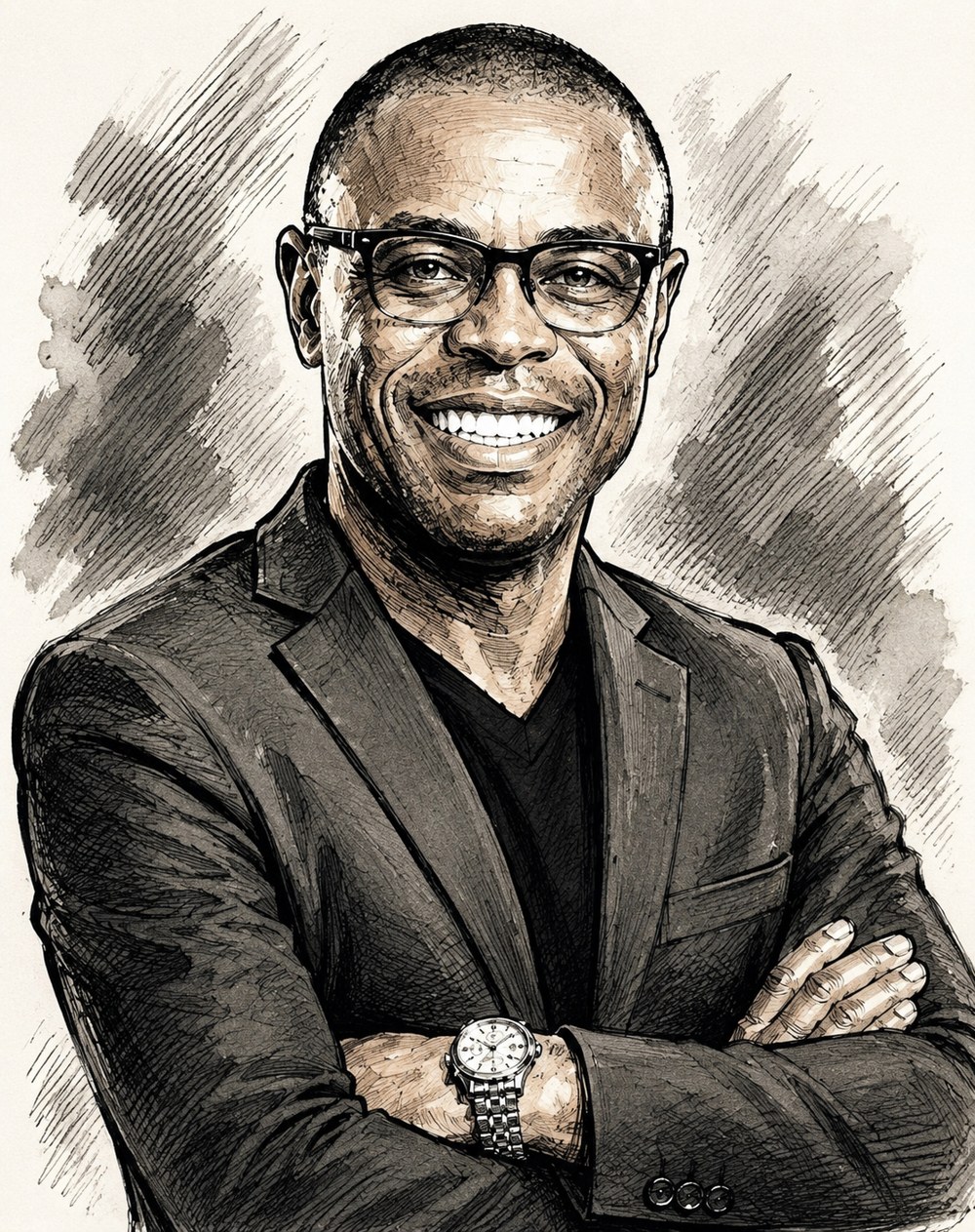
In his own words
“Every profession has its illusions. Journalism perhaps more than most. From the outside, it appears to be a craft devoted to truth: reporters travelling across continents, observing events, collecting facts, and sending them back to the world. The image is reassuring.
But stories are never neutral.
For more than a decade I lived inside that system. I reported from cities and conflict zones, attended press briefings and diplomatic meetings, and watched the global news cycle turn with relentless speed. It was an extraordinary vantage point. And yet, from very early on, I sensed that something about the way the world was being described did not entirely match the world I knew. This book is an attempt to understand that gap.”
An outsider inside the room
Between 1997 and 2008 he belonged to a small and peculiar tribe — foreign correspondents scattered across Montreal, New York, Arusha, Kampala and Geneva, a world almost entirely composed of Western journalists working for Western outlets. That a Black man from Cameroon found himself inside that circle never stopped surprising him. He describes himself in those years as “both participant and anomaly”, and it is that double position that eventually produced this book.
The other source
The second source lies in his years as a student — sociology in Douala and Yaoundé in the mid-1990s, political science in Geneva in the late 2000s — and in a constellation of thinkers he read and, in several cases, met: Achille Mbembe, Jean-Marc Ela, Mongo Béti, Jean Ziegler, Pierre Bourdieu, Serge Halimi, Noam Chomsky, Edward Said.
At nineteen, a sociology student in Douala with, in his phrase, “more ambition than sense”, he wrote letters to Bourdieu and Halimi in Paris and entrusted them to the brother of a friend flying to France. Both letters arrived. Both men replied — with books that were then almost impossible to find in Cameroon, and with encouragement he kept for years.
Fifteen years in a drawer
Most of Echoes of Empire was written more than fifteen years ago, out of a master's thesis supervised at Geneva by Léa Sgier, and then set aside as careers and responsibilities accumulated. The delay turned out to be instructive. The patterns first observed in 2007 had not faded; if anything they had deepened. As he puts it, the arguments needed almost no revision — “reality, unfortunately, did the updating for me.”
Speaking and teaching
Available for guest lectures, seminars, newsroom training, panels and festival appearances, in English or French, in person or online.